
Help · Crypto & Security
Validate Ethereum and Bitcoin Addresses Before You Reuse Them
Wallet addresses are easy to mistype and hard to read at a glance. A single missing character, wrong prefix, or checksum mismatch can turn a routine support task into a risky handoff.
Appkiro's Ethereum Address Validator and Bitcoin Address Validator give you a quick browser-based check before an address is reused in documentation, tickets, scripts, CSV files, or wallet workflows.
Quick answer
Use Ethereum Address Validator for addresses that start with 0x and may use EIP-55 checksum casing. Use Bitcoin Address Validator for Bitcoin legacy, SegWit, Bech32, and Bech32m addresses where network, prefix, and checksum rules depend on the address format.
The two validator workspaces
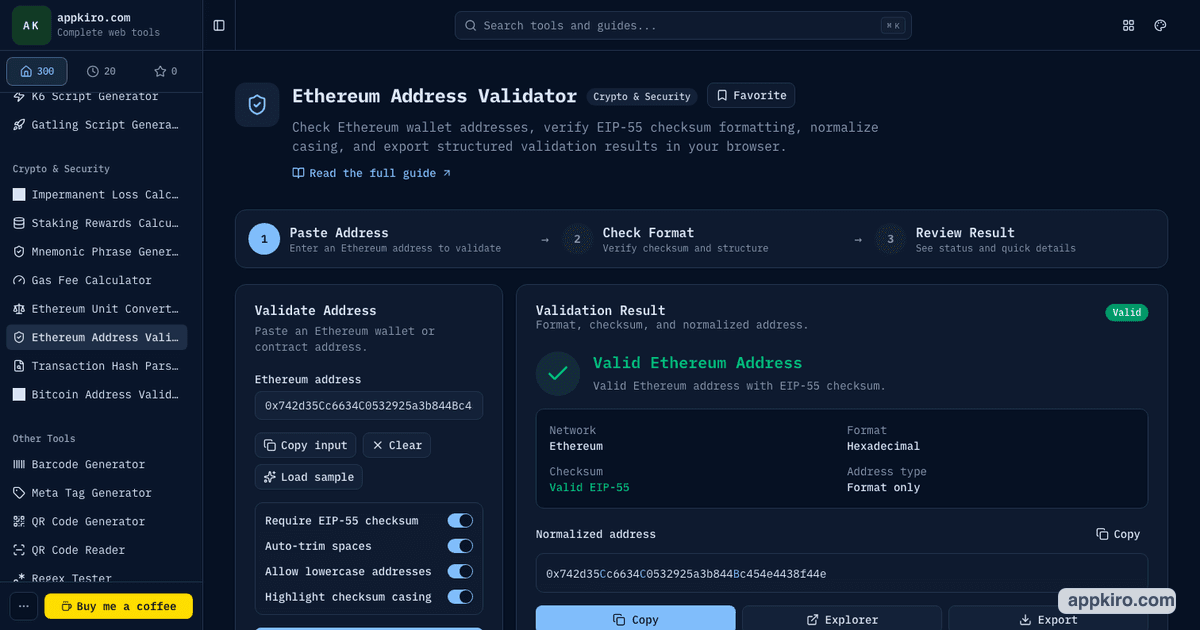
Ethereum Address Validator
Checking Ethereum-style wallet addresses before they go into support notes, CSV imports, test fixtures, smart contract docs, or payment instructions.
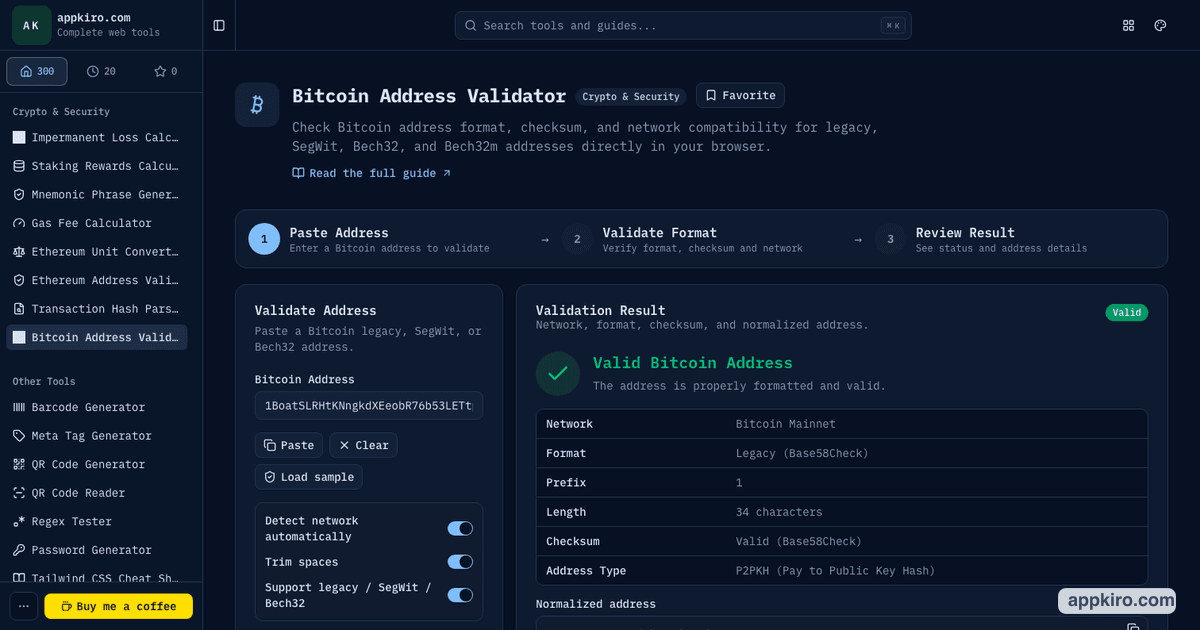
Bitcoin Address Validator
Checking Bitcoin addresses across legacy, SegWit, Bech32, and Bech32m formats before sharing them or adding them to operational workflows.
How to validate a crypto address
- 1
Paste the address exactly as received
Start with the original address from a wallet, customer message, QR scan, API response, CSV row, or documentation draft. Avoid manually fixing characters before the first check because the validator is there to catch those mistakes.
- 2
Choose the validator that matches the chain
Use Ethereum Address Validator for 0x Ethereum-compatible addresses. Use Bitcoin Address Validator for Bitcoin legacy, SegWit, Bech32, or Bech32m addresses.
- 3
Review format, checksum, and network
A valid-looking address still needs the right network and checksum behavior. Ethereum mixed-case addresses can carry an EIP-55 checksum, while Bitcoin addresses use Base58Check, Bech32, or Bech32m depending on the address type.
- 4
Copy or export the validation result
Use Copy Result or Export JSON when you need a traceable note for a ticket, QA report, internal tool, or handoff. Keep the original address nearby so reviewers can compare it with the normalized output.
- 5
Confirm ownership and balance elsewhere
Address validation does not prove ownership, balance, transaction history, or whether the address belongs to the intended person. Use a wallet, block explorer, or signed message workflow for those checks.
Ethereum vs Bitcoin address checks
What Ethereum validation checks
Ethereum addresses should start with 0x followed by 40 hexadecimal characters. If the address uses mixed case, EIP-55 checksum rules can help catch typing mistakes. All-lowercase and all-uppercase addresses can still be structurally valid, but they do not carry the same checksum signal.
What Bitcoin validation checks
Bitcoin addresses vary by format. Legacy P2PKH and P2SH addresses use Base58Check, while native SegWit and Taproot-style addresses use Bech32 or Bech32m. The validator checks both the character rules and checksum for the detected format.
Why network matters
A testnet or regtest address is not the same as a mainnet address. Bitcoin prefixes often reveal the network. Ethereum addresses do not include network information, so network context must come from your wallet, app, documentation, or transaction flow.
What validation cannot prove
A format check cannot prove that funds will arrive safely. It does not confirm ownership, intent, malware-free clipboard state, account balance, or smart contract behavior. Treat it as a first-line typo check, not a complete security review.
When these validators are useful
- Checking a wallet address before pasting it into a support ticket or internal note
- Reviewing CSV imports that contain payout addresses or test wallet data
- Cleaning examples for documentation, API samples, tutorials, and QA fixtures
- Verifying whether a copied Bitcoin address is legacy, SegWit, Bech32, or Bech32m
- Confirming whether an Ethereum mixed-case address passes EIP-55 checksum rules
- Exporting a small JSON validation record for audit notes or developer handoff
Practical safety notes
- Do not remove characters until you have seen the validation error. The exact failure often explains the copy or formatting problem.
- For Ethereum, prefer checksum-cased addresses when sharing addresses in documentation or support workflows.
- For Bitcoin, check the detected network before using an address from test fixtures, staging wallets, or developer tools.
- Watch for clipboard replacement attacks. If the address changed after copying, validation alone will not know the intended recipient.
- Use a block explorer only to inspect public chain data. It cannot prove that the address belongs to the person who sent it.
Copy and export options
Copy normalized results
Copy the cleaned address or validation summary when you need to paste a concise result into a support note, pull request, or internal message.
Export JSON for records
Export JSON when a workflow needs structured fields such as validity, checksum status, network, address type, and normalized address.
Related tools
Inspect a transaction hash after a transfer has been submitted.
Ethereum Unit ConverterConvert ETH, Wei, and Gwei while checking gas or value examples.
Base58 Encode / DecodeInspect Base58 text when working around Bitcoin-style encodings.
Hash GeneratorGenerate hashes for developer notes and checksum-related debugging.
FAQ
Can these tools tell me whether an address has funds?
No. The validators check address structure, checksum, and detected format. Balance, ownership, contract code, and transaction history require a wallet or block explorer lookup.
Is an all-lowercase Ethereum address invalid?
Not automatically. An all-lowercase Ethereum address can be structurally valid, but it does not carry an EIP-55 checksum. Mixed-case addresses can be checked against the checksum rule.
Why does Bitcoin have more address formats than Ethereum?
Bitcoin has several address families from different script and witness formats, including legacy Base58Check, native SegWit Bech32, and Bech32m for newer witness versions. Ethereum externally owned accounts and many EVM addresses use the same 0x plus 40 hex character shape.
Can I use the Bitcoin validator for testnet addresses?
Yes. The Bitcoin validator can identify common mainnet, testnet, and regtest-style prefixes where the address format supports that distinction.
Should I trust validation before sending crypto?
Use validation as one check, not the final decision. Confirm the recipient, network, wallet UI, amount, and destination before sending. For high-value transfers, use a small test transaction or a signed-message workflow when appropriate.
Start with the address format
Pick the chain first, validate the address, then confirm ownership or balance in the right wallet or explorer.