
Understand Impermanent Loss Before You Provide Liquidity
Impermanent loss sounds more complicated than it is. If you put two tokens into a liquidity pool, the pool keeps rebalancing those tokens as prices move. Appkiro's Impermanent Loss Calculator shows whether that LP position is doing better or worse than simply holding the same tokens, and whether fees or rewards are enough to make the position worthwhile.
The simple idea
Imagine you start with 5 ETH and 10,000 USDC. ETH is priced at 2,000 USDC, so the total position is worth 20,000 USD. You can either hold those tokens in your wallet, or deposit both into an ETH / USDC liquidity pool.
If ETH later moves to 1,600 USDC, the pool will not still hold exactly 5 ETH and 10,000 USDC for your share. An AMM changes the token balance as traders swap against the pool. Impermanent loss measures the gap between the rebalanced LP position and the simple hold strategy.
LP position
The value of your share inside the liquidity pool after token prices move.
HODL value
The value of the original tokens if you had kept them outside the pool.
Impermanent loss
The difference between LP value and HODL value before fees and rewards.
How to use the calculator
- Choose or enter a token pair. Use a preset such as ETH / USDC, SOL / USDC, MATIC / USDC, WBTC / ETH, or MEME / ETH, or type your own symbols.
- Select the AMM or pool type. The default Uniswap V2 constant-product model is the common baseline. Weighted or stable-pair options are approximate models for lower or different IL behavior.
- Enter the starting amounts. Token A and Token B amounts represent what you add to the pool at the beginning.
- Set the initial and new price. The price change is the main driver of impermanent loss. The shortcut buttons let you simulate drops or rises quickly.
- Add fees and rewards. Trading fees and farming rewards are counted separately so you can see the raw IL and the final result after income.
- Review the LP vs HODL comparison. The result panel shows whether the pool position is behind or ahead after the simulated price move.
What every input means
Token A and Token B
These are the two assets in the pool. In ETH / USDC, ETH is Token A and USDC is Token B. The calculator uses Token B as the pricing unit.
Token amounts
These are the starting amounts you put into the pool. If the initial price is balanced, the two sides usually have similar dollar value.
Initial price
This is Token A's price at the moment you enter the pool. For ETH / USDC, 2,000 means 1 ETH equals 2,000 USDC.
New price
This is the price you want to simulate. A lower new price models Token A falling. A higher new price models Token A rising.
AMM / Pool Type
This controls the approximate pool behavior. Constant-product pools rebalance aggressively. Stable or weighted models can show lower estimated IL, but real protocols may differ.
Trading fees earned
This is the fee income you estimate from swaps in the pool. It is added after raw LP value, because fees can reduce or offset IL.
Farming rewards
These are extra incentives such as liquidity mining rewards. Treat them as estimates unless you have exact realized rewards.
Pool APR
This is a reference rate for the pool. In this tool it is shown for context and export; it does not replace your fee and reward inputs.
Auto-calculate token rebalance
When enabled, the calculator estimates how the pool rebalances your token mix as price changes. Turning it off removes that rebalancing effect for comparison.
Include fee income in ROI
When enabled, fees and farming rewards are included in Net PnL and Final ROI. Raw impermanent loss is still shown separately.
How to read the result
Impermanent Loss
The percentage and value difference between LP and HODL before counting fees and rewards.
LP Position Value
Estimated value of your pool position after the price move, before fee income.
HODL Value
What the same starting tokens would be worth if you never entered the pool.
Net PnL vs HODL
LP value plus fees and rewards, minus HODL value. Positive means the LP estimate beats holding.
The most important number is not always the raw impermanent loss. A pool can show negative IL but still have a positive final result if trading fees and rewards are large enough. That is why the tool separates Impermanent Loss, Fees Earned, Farming Rewards, Net PnL vs HODL, and Final ROI vs HODL.
Example: ETH falls after you add liquidity
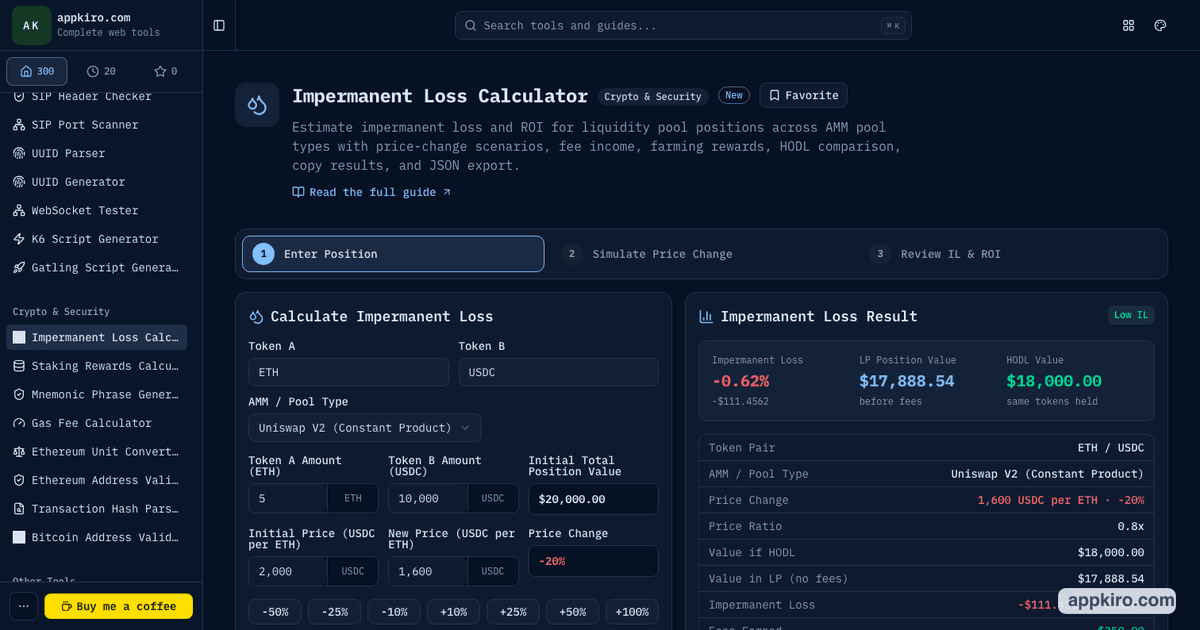
Start with 5 ETH and 10,000 USDC when ETH is 2,000 USDC. The starting value is 20,000 USD. Now simulate ETH falling to 1,600 USDC, a 20% drop.
HODL value: 5 ETH is now worth 8,000 USDC, plus the original 10,000 USDC, so holding is worth 18,000 USD.
LP value before fees: the pool rebalances the position, so the estimated LP value is lower than 18,000 USD.
Raw impermanent loss: this is the LP value minus the HODL value.
Final result: add trading fees and farming rewards to see whether the LP position still wins after income.
Screenshot
Important limits
The calculator is an estimate. Real pools can include concentrated liquidity ranges, changing pool weights, dynamic fees, slippage, gas costs, token taxes, reward vesting, incentive changes, smart contract risk, and price movement while you enter or exit the pool. Use the result to understand the tradeoff, then verify details in the actual protocol before committing funds.
Related tools
FAQ
What is impermanent loss in simple words?
Impermanent loss is the difference between what your liquidity pool position is worth and what the same tokens would be worth if you simply held them in your wallet.
Why is it called impermanent?
It is called impermanent because the loss can shrink if the price ratio moves back toward where it started. It becomes a realized result when you remove liquidity or otherwise close the position.
Can trading fees make up for impermanent loss?
Yes, sometimes. Fees and farming rewards can offset the loss, but they are not guaranteed and may be smaller than the loss during strong price moves.
Does this calculator use live DeFi data?
No. It uses your inputs and static presets. The numbers are planning estimates, not live pool data or financial advice.
Does this work for concentrated liquidity positions?
The main estimate is based on a constant-product AMM model. Concentrated liquidity positions can behave differently when the price moves outside the active range.